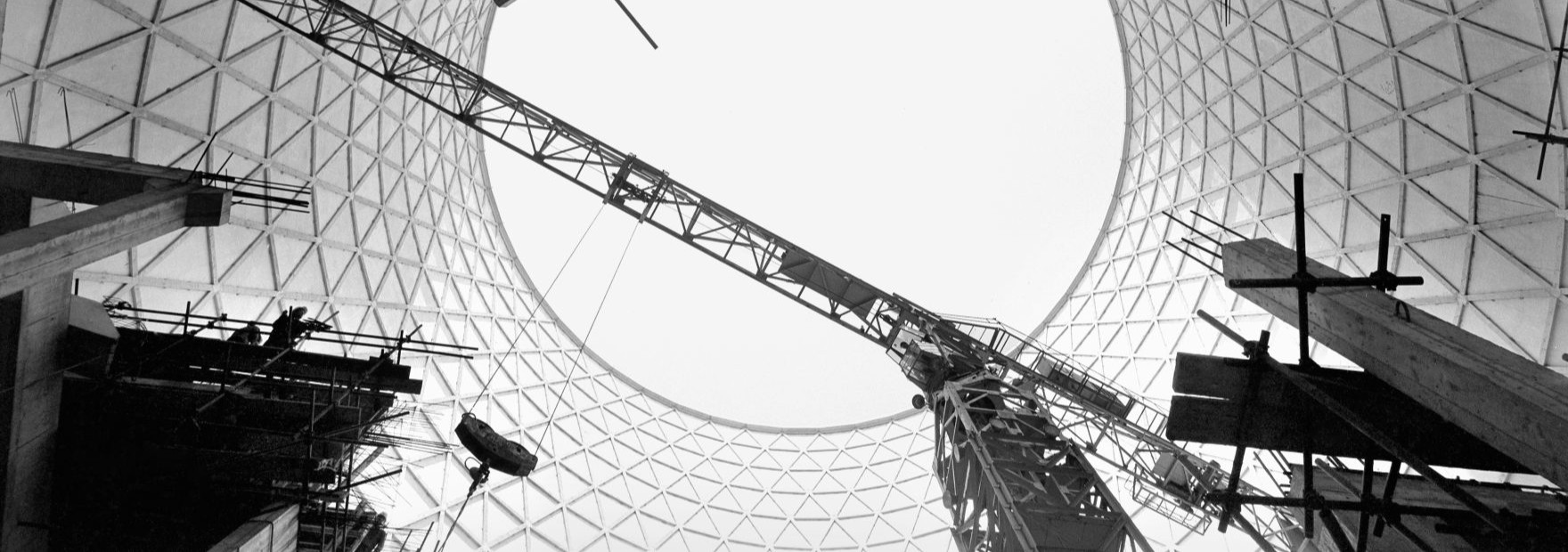
Photo exhibition
On view until: January 2026
Where: Museum platform
Exhibition authors: Dr. Monika Močnik, Irena Ribič
This October, one of the most important names in Slovene construction, the GRADIS company, would have celebrated its 80th anniversary. Its history is an important part of Slovenia’s economic and infrastructural development, while also reflecting the broader processes of social, political and economic transformation that marked the former Yugoslavia and independent Slovenia.
The GRADIS construction company, more precisely Ministrstvo za gradnje, Gradbena direkcija Slovenije »GRADIS«, državna gradbena podjetja, centrala Ljubljana (Ministry of Construction, Construction Directorate of Slovenia “GRADIS”, state construction companies, headquarters in Ljubljana), was established under the regulations of a decree of the National Government of Slovenia on 4 October 1945. It was created by merging and nationalizing several former construction companies in Ljubljana and the surrounding area, such as Dukić ing. in drug, Gradbeno podjetje ing. Josip Dĕdek, podjetje Slograd and others. From the very start, the company employed more than 3,000 workers, who worked on large-scale construction projects across Slovenia and Yugoslavia. As the largest Slovene construction company, it significantly contributed to the development of the post-war country in various fields – it built hydroelectric power plants, ironworks, factories and residential neighbourhoods and played a role in the establishment of the road and electricity network. It combined several other activities in addition to construction: wood industry, design, transport engineering and ironwork.
Shortly after its establishment, the company issued its first rules of procedure, which regulated and laid the foundations for technical, commercial and administrative management. This made GRADIS one of the best organized construction companies and a leader in the technological development of Slovene and Yugoslav construction.
Over the years, the company more or less successfully adapted to both political and economic changes. In 1964, it opened a branch in the Federal Republic of Germany, and later had construction sites at home, in Bosnia and Herzegovina and Montenegro, and also penetrated the markets of Iraq, Libya, Kuwait etc.
At the beginning of the new millennium, GRADIS, like many Slovene companies, unfortunately collapsed under the weight of the loss of markets in the former Yugoslavia, and the consequences of transition and restructuring within the new system.
This exhibition is an expression of thanks to the former employees of GRADIS and the Chamber of Construction and Building Materials Industry at the Chamber of Commerce and Industry of Slovenia. At the same time, we are announcing the publication of an extensive collection of papers that will comprehensively present the history and achievements of this Slovene construction company, which was the pride of many generations of Gradis workers.