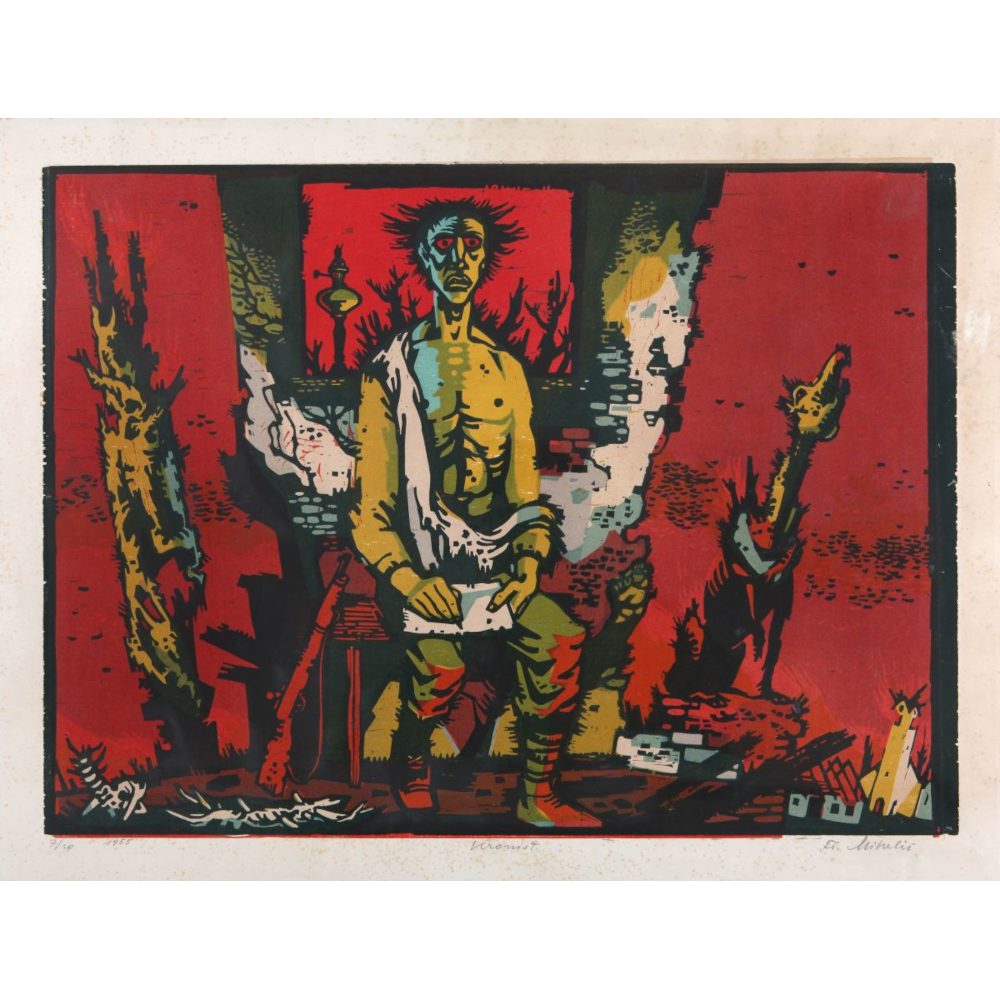
France Mihelič first conceived the motif of the chronicler in 1944, during the Second World War. He later developed it further in both printmaking and painting. The present print was first exhibited at the 1st International Exhibition of Graphic Arts in Ljubljana in 1955. Mihelič presented five prints at this exhibition and was awarded a prize by the biennial jury.
The Chronicler portrays a fantastic, apocalyptic image of the artist as a chronicler – a faithful documentarian of the horrors of war. The work features a range of Mihelič’s characteristic metaphors: a burned village, a howling dog, a kerosene lamp, a window, and a scorched tree.
Throughout his oeuvre, Mihelič created multiple versions of the chronicler motif in printmaking, in both black-and-white and color. The depiction of the central human figure varies slightly from print to print, but over time the chronicler becomes increasingly grotesque and deformed. As the chronicler records the brutal realities of war, his body itself becomes marked by the horrors he continuously witnesses. The figure is half-naked, draped only in a torn white cloth – a ruined remnant of former clothing.
In the color version of the print, the chronicler gazes directly at the viewer, his stare fixed, either petrified by horror or paralyzed by rage. He holds a pen in his hands, faithfully recording the unfolding events. His movements appear almost robotic – as if his hand moves independently of his body, automatically gliding over the sheet of paper resting on his knees. This mechanical detachment emphasizes a sense of automated recording, devoid of emotional distance.
The figure is dramatically rendered in contrasting hues of yellow, green, red, and blue, enhancing the work’s fantastical, surreal atmosphere. Positioned centrally, the chronicler sits on an emphasized seat that resembles a throne or portal – but is, in reality, the ruin of a destroyed building. His despair clearly arises from his surroundings: a desolate landscape echoing the devastation left in the wake of World War II.
Two of Mihelič’s signature motifs also appear in the composition: a scorched tree, symbolizing both destruction and the resilience of life in the face of utter hopelessness, and a howling dog or wolf. This latter motif allows for multiple interpretations – as a warning cry of impending danger, a sinister harbinger of destruction, or a utopian plea for help, sent skyward.